Plumbers In LiverpoolLicensed · Local · 24/7 1300 381 569
Blocked drains

Blocked drains cleared
across Liverpool

Sixty-year-old earthenware under mature street trees, or six-year-old PVC with the builder's leftovers still in it. Both block, for opposite reasons. We ask the age of the house before we load the van.

Same-day clearingNSW Lic. 368473CRoot cutting & CCTV
Call 1300 381 569

Get a drain callback

Online Now!·--:--

No obligation · Licensed & insured · Fixed price upfront

Why drains block in Liverpool homes

The first question we ask on a Liverpool drain call is not what is blocked. It is how old the house is, because this is a city with two housing stocks that fail in completely different ways.

One half is the estates built from the 1960s onward, Green Valley and the suburbs around it, Miller, Cartwright, Ashcroft, Sadleir and Busby. Their sewers are earthenware, laid in short lengths with a joint between each one, and the street trees planted when those estates went up are now six decades mature. Every joint weeping slightly is a dependable water source, and roots find it. That is the recurring annual blockage.

The other half is the growth area estates on the old farmland out toward Leppington, Austral, Edmondson Park and Middleton Grange. Those lines are solvent-welded PVC with no joints a root can enter, so roots are almost never the answer there. What blocks them is what went down them while the house was being built: render, tile adhesive, grout, sand through an open riser, offcuts. It sits in the line from the day the slab went down.

That second one catches people badly, because a blockage in a house you bought new feels like something you must have done. Usually it is not, and there is a reasonable chance it is not your cost either.

Licensed plumbers at the workshop
  • Same-day clearingCleared without flooding the house
  • Root cutting on the vanNot just an eel through the middle
  • Camera on newer homesDebris looks nothing like roots
  • Licensed plumberNSW Licence 368473C, fully insured
Service van on its way to a Liverpool job

Cleared today, not booked in for next week.

Tell us roughly when the house was built. On a 1960s place we bring the cutter, on a newer one we bring the camera, and that one answer saves you a second visit.

Local drain guide

What actually blocks drains in Liverpool

The old estates: joints, trees, and sixty years

The public housing built through Green Valley from the early 1960s was laid with earthenware sewer, which comes in short lengths with a joint between each one. Sound when installed, but ground moves, and after six decades a proportion of those joints are weeping.

The street trees went in at the same time and have had exactly as long to grow. Roots do not hunt for pipes, they hunt for moisture, and a joint releasing a little water is the most dependable water in the ground through a dry month. Once a fine root is through, it thickens inside the pipe where there is water and nothing competing with it.

The new estates: nothing gets in, plenty was already there

Solvent-welded PVC has no joint a root can penetrate, so in the growth area suburbs roots are close to a non-issue. That is a genuine improvement and it is worth knowing.

What replaced it is a construction problem. The drainage goes in early and stays open through months of trades. Render and mortar rinse off tools, grout and adhesive go down the nearest gully, silt washes in through a riser nobody capped. It settles at the low point and waits. Households then live over it for a year or two before enough builds up behind it to matter.

Which is why we camera a newer home earlier

On an older house, a first blockage usually just gets cleared. Something went down, it is out, done.

On a house under about ten years old we will suggest the camera on the first blockage rather than the second, because the footage answers a question that is worth real money. Construction debris is unmistakable on camera and looks nothing like roots or a fat build-up, and if that is what it is, the conversation you are about to have is with your builder rather than with us.

Statutory warranty is a real thing and it has a clock

Residential building work in New South Wales carries statutory warranties under the Home Building Act. The periods run from completion of the work: six years for a major defect, two years for everything else. They pass to subsequent owners for whatever remains, so buying the house second-hand does not extinguish them.

Whether a given blockage falls inside that is a question for advice, not for a plumber, and we will not pretend otherwise. What we can do is document it properly while the evidence still exists, which is the part people miss. Clear it first, lose the proof, and the claim gets much harder.

Cut, then seal, on the older lines

Where roots are the cause, mechanical cutting is the right immediate answer and it restores full flow the same day. But it does nothing about the joint they came through, so they come back on roughly the same interval.

Sealing that section with a cured liner removes the entry point permanently. On a sixty-year-old earthenware line under a sixty-year-old street tree, that is usually the difference between an annual call-out and a job you do once.

What clearing a blocked drain costs in Liverpool

Quoted at a fixed price before it starts. These are indicative 2026 ranges. On a home under about ten years old we will recommend the camera with the clear, because if what comes up is construction debris, the footage is worth a great deal more than it costs.

01

Clear a blocked drain $150 – $400

Hand tools or an electric eel through an existing access point. Most one-offs land here.

02

Root cutting $400 – $900

Mechanical cutting back to clean pipe wall. The older estates, priced on what is in there.

03

Camera inspection $250 – $450

Down the line with the footage handed over. What a warranty conversation needs.

04

Jetter on a stubborn line $400 – $700

High-pressure water where an eel will not shift it, or to flush after cutting.

05

Written report included

Issued with the footage. Useful for a builder, an insurer or a buyer.

How a blocked drain call-out runs.

Step 01
Taking a blocked drain call for a Liverpool property

How old is the house?

The question that decides everything else. A 1960s estate and a five-year-old build get different gear, and we would rather ask than guess.

Step 02
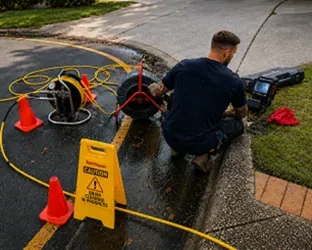
Clearing a blocked sewer line at a Liverpool property

Cleared through the nearest access

We work from the closest existing access point so nothing backs up through the house while the line is being cleared.

Step 03
Running a drain camera at a Liverpool property

Camera down anything newer or recurring

Roots, debris and a collapse look nothing alike on screen. On a newer home this is the step that tells you whose problem it is.

Step 04
Handing over drain camera footage and a report in Liverpool

Footage, report, and a straight answer

You get the vision and a written report. If the cause looks like a build defect we will say so plainly, and document it properly.

Drain backing up right now?

Stop using every fixture on that line, the washing machine included. Then tell us roughly what year the house was built, it changes what we bring.

Call 1300 381 569
Licensed Liverpool plumber ready to take your call

Blocked drain questions.

What Liverpool locals ask us before booking a plumber.

Ask us yours Licensed plumbing van covering Liverpool and the surrounding suburbs
Does it matter how old my house is?

More than anything else you could tell us. Liverpool has two very different housing stocks and they fail in opposite ways. A house from the 1960s Green Valley estates has jointed earthenware sewer with mature street trees over it, so the answer is almost always roots. A house in one of the growth area estates has solvent-welded PVC that roots cannot get into at all, so it is almost never roots, and it is very often something left in the line during construction. Same symptom, completely different job. Telling us the age of the house at the booking is what gets the right gear on the van.

My house is nearly new. How can the drain already be blocked?

Because the drain was in the ground before the house was finished, and a lot happens over it in between. Render and mortar get washed off tools, tile adhesive and grout go down the nearest gully, sand and silt wash in through an uncapped riser, and offcuts get dropped in. None of it dissolves. It sits in the low point of the line from day one, and it does not become a blockage until enough normal use builds up behind it, which is often a year or two after you moved in. A camera settles it quickly, because construction debris looks nothing like a root mass or a fat build-up.

If it is a building defect, is it my cost?

It may not be. Residential building work in New South Wales carries statutory warranties under the Home Building Act, and the period runs from completion of the work: six years for a major defect and two years for everything else. Those warranties also pass to later owners for whatever is left of the period, so you do not have to be the original purchaser. Whether a particular blockage falls inside that is not a plumber's call to make, but the camera footage and a written report are what any claim needs, and we hand both over as a matter of course. Get the evidence first, then take advice.

Why does it happen every year at my place?

That pattern is the older estates, and it means roots. Earthenware sewer was laid in short lengths with a joint between each one, and every joint that weeps slightly is a reliable source of water in the ground. The street trees planted through Green Valley when the estate went up in the 1960s are now sixty years mature, with root systems to match. Cutting clears the line but leaves the joint open, so they return on roughly the same schedule. Sealing that joint with a liner is what ends it.

Are “flushable” wipes actually flushable?

No. They pass the S-bend, which is all the label really promises, then fail to break down the way paper does. In an older line that already has roots in it they are much worse than usual, because the roots give them something to catch on. In a newer line with construction debris sitting in it, they do exactly the same thing against the debris. Either way they turn a slow line into a sudden one.

Do chemical drain cleaners work?

Rarely, and the root-killer products are worth being sceptical about. They do not remove the mass, they do not close the joint the roots came through, and the tree regrows. On a solid obstruction they simply sit on top of it. They also generate heat and make the water we then have to work in caustic, so if you have poured something down, tell us when you call rather than after we arrive.

What does clearing a blocked drain in Liverpool cost?

Most clears through an existing access point are $150 to $400. Root cutting is $400 to $900 depending on how much is in the line. A camera inspection is $250 to $450 with the footage handed over. On a newer home we will usually recommend the camera even on a first blockage, because if it turns out to be construction debris the footage is worth considerably more than it costs.

Licensed Liverpool plumber arriving with his tools

Get the drain cleared in Liverpool

Tell us roughly when the house was built and whether this has happened before. On an older estate that points to roots, on a newer build it points somewhere quite different.

Fixed price agreed before we start, and on a newer home, footage you can actually use.

1300 381 56924/7 emergency line
[email protected]Non-urgent enquiries
Servicing Liverpool & districtNSW Licence 368473C

Get a drain callback

Online Now!·--:--

No obligation · Licensed & insured · Fixed price upfront

Call now