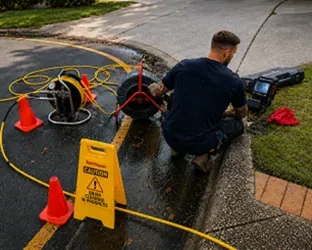
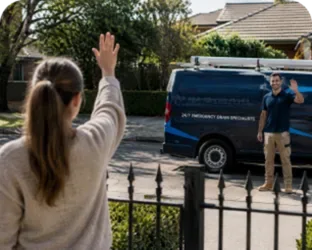
The pipe repaired from the inside, through an existing access point. No trench, and nothing to reinstate afterwards, which on a block where the sewer runs under the driveway is most of the cost avoided.
Online Now!·--:--
Relining is often sold on the technology. The reason it makes sense here is much more ordinary: it is about what sits on top of the pipe.
On the newer estate blocks, the house covers most of the lot and nearly everything left over is hard surface. Driveway, path, paved courtyard, alfresco slab. The sewer runs under it because there is nowhere else for it to run. Excavating that line is not really a plumbing cost, it is a demolition and reinstatement cost with some plumbing in the middle, and the reinstatement is usually the biggest number on the page.
On the older estates the surface is different but the logic holds. There you are dealing with sixty-year-old earthenware laid in short jointed lengths, under gardens and street trees of the same vintage. The repeat blockages are roots coming through joints, and cutting them out each year treats the symptom while leaving the opening exactly as it was.
In both cases the liner does the same thing: it puts a continuous jointless pipe inside the old one, through an access point that already exists, without anything being opened up. On one type of block that saves the driveway. On the other it ends the annual call-out.


That pattern means the pipe, not what went down it. Tell us how many times and what is over the line, and we will tell you whether a liner is the right conversation.
An excavation quote and a relining quote often look far apart until you read what the excavation includes. Breaking out a driveway, removing the spoil, doing the repair, backfilling and compacting properly, then reinstating a surface that matches the rest is a sequence of trades.
On a block where the line runs under concrete, that reinstatement routinely costs more than the plumbing did. Relining does not avoid a bit of that cost, it avoids all of it, which is why the comparison changes so sharply once both quotes are written out in full.
Earthenware sewer is laid in short lengths with a joint between each. After six decades a proportion of those joints are weeping, and a weeping joint is the most dependable water in the ground during a dry spell.
Cutting the roots clears the line and changes nothing about the opening. A cured liner leaves no joint in the section it covers, so the roots that regrow meet continuous pipe wall instead of a gap. That is the difference between managing it annually and finishing with it.
If the line in a recently built house is damaged, the useful question is why. Construction damage and incorrect laying both happen, and both may sit inside the statutory warranties for residential building work.
Relining repairs the pipe and, in the process, covers over the evidence of what was wrong with it. So on a newer property we film first, hand over the footage and a written report, and let you take advice before committing. Occasionally the right outcome is that we do not do the job at all, and that is fine.
A liner needs a host pipe with enough structure left to cure against. Where a line has fully collapsed, or lost so much wall that there is nothing to press onto, replacement is the honest answer.
A joint thrown badly out of line rules it out too. The camera settles which situation you are in, and that is precisely why we will not quote a reline without one. Anyone offering a price down the phone is guessing with your money.
The footage shows where the line runs, which joints are being used, how much wall is left and whether there is a fall problem or a sag holding water. Those are different problems with different answers.
You keep the vision and the report either way. It is useful with a builder, useful with an insurer, and genuinely useful to a buyer if you sell, because the state of the sewer is not something anyone can see from the garden.
Quoted from the camera footage, never from a guess. Indicative 2026 Sydney ranges. Compare them against an excavation quote that includes reinstating whatever is currently over the pipe, because that is the real alternative.
Required before any reline is quoted. Footage and written report handed over.
A short liner over a single failed or root-damaged section.
House to boundary, priced on length, diameter and access.
Each branch cut back and finished cleanly after the liner cures.
In writing, issued with the post-reline footage so you can see what you bought.

No liner gets quoted without footage. It decides whether relining is even appropriate, and where it needs to start and stop.

Roots cut back and the pipe wall cleaned, because a liner cures against what is actually there rather than what we hoped was there.

Inverted through the existing access point, inflated tight to the wall and cured in place. Nothing opened, nothing to reinstate.

A second camera run so you can see the finished pipe, with the footage and the fifty-year warranty handed over.
Ask what the reinstatement is costing you separately. On a block where the line runs under the driveway, that answer usually reframes the whole decision.
Call 1300 381 569
A resin-saturated liner is pulled or inverted into the damaged section of pipe through an existing access point, inflated so it presses tight against the old pipe wall, and cured until it hardens. What you end up with is a continuous jointless pipe formed inside the old one, structurally sound in its own right and typically warranted for fifty years. Nothing is excavated to do it, which on most Liverpool properties is the entire point.
Because of what is over the pipe. On the newer estate blocks the house occupies most of the lot and the remainder is driveway, paving and courtyard, so the sewer very often runs under a hard surface rather than under lawn. Excavating means cutting concrete, removing it, doing the plumbing, then reinstating a driveway or a paved area so it matches what was there. That reinstatement is frequently the largest line on the invoice, and it is the part relining removes entirely. On the older estates it is usually a mature front garden and a street tree instead, but the arithmetic works out much the same.
It closes the way in, which is the part that matters. Roots enter through joints and cracks, not through sound pipe wall, and a cured liner leaves no joint and no crack in the section it covers. The tree carries on and its roots carry on looking for water, but there is no longer an opening for them at that point. That is why cutting then lining is the standard answer on a line that has blocked repeatedly, whereas cutting alone simply resets the clock.
Ask that question before the repair, not after. If a camera shows a line damaged during construction, or a section that was never laid correctly, that may fall under the statutory warranties for residential building work: six years for a major defect, two years otherwise, running from completion, and they pass to later owners. Relining fixes the pipe and in doing so removes the evidence of what was wrong with it. So on a newer home we film it, hand over the footage and a written report, and let you take advice before you decide. We would rather do that than sell you a liner you did not need to pay for.
Most residential relines are done in a day. The line is out of service while the liner cures, which is generally a few hours, and we will tell you the window before we start so you can plan around it rather than discover it. There is no excavation, so there is no reinstatement afterwards and no waiting for concrete to cure or turf to knit.
No, and anyone who says otherwise is selling. It needs a host pipe with enough structure left to line against. A line that has fully collapsed, or one that has lost so much wall that there is nothing to press the liner onto, needs replacing rather than lining. Severe misalignment at a joint can also rule it out. The camera is what tells us which situation you are in, and we would rather find that out before quoting than halfway through.
A short patch over a single failed joint is generally $2,000 to $4,000. A full run from the house to the boundary is usually $4,500 to $9,000 depending on length, diameter and access. Junction reinstatement is $600 to $1,200 each. Those numbers look large next to a drain clear, and they compare very differently once you add excavation plus reinstating a driveway or a paved courtyard, which is the real alternative on most blocks here.
Tell us how many times it has blocked and what is over the line. If the house is newer, say so, because filming it before repairing it may be worth more to you than the repair.
Camera first, quote from the footage, and a straight answer if relining is not the right fix.
Online Now!·--:--